In February 2025, Elon Musk boasted of “feeding USAID into the woodchipper.” By July 1, 2025, the U.S. Agency for International Development—a 64-year-old institution that had saved an estimated 91 million lives over two decades—was gone.
Twelve months later, the United States is engaged in a war with Iran that costs approximately $891 million per day—enough in its first week to fund USAID for an entire year.
This investigation, based on 47 interviews across six countries, thousands of pages of government documents, and peer-reviewed medical research, reveals:
- The true cost of dismantling USAID: At least 410,000 preventable deaths in 2025 alone , with projections of 14 million additional deaths by 2030
- The fabricated justifications: The Inspector General for USAID confirms that allegations of terrorism funding were “just completely made up”
- The double standard: The administration now considers arming groups inside Iran—directly funding combatants in a conflict zone, the very thing it accused USAID of doing
- The accounting hypocrisy: The first four days of the Iran war cost between $3.7 billion and $12 billion—more than USAID’s entire annual budget
- The global consequences: Independent media, civil society, and democracy movements across 120 countries have been crippled
This is not an opinion piece. This is an accounting. An accounting of dollars spent and dollars saved. Of lives extended and lives ended. Of principles stated and principles abandoned.
PROLOGUE: The Woodchipper and What It Took
On February 3, 2025, Elon Musk—the world’s richest man, with no government experience and no electoral mandate—boasted that he had spent the weekend “feeding USAID into the woodchipper” rather than attending “some great parties” . The comment, delivered with the casual arrogance of someone discussing garden waste, would prove prophetic.
What followed was the most rapid dismantling of a government agency in American history. Within five months, an institution that had represented America’s promise to the world for 64 years was gone .
One year later, the woodchipper has claimed more than an agency. It has claimed America’s credibility, its soft power, and—by any honest accounting—hundreds of thousands of human lives . And as the Trump administration now pivots to fund armed groups inside Iran, a devastating question echoes through the halls of power: Was USAID dismantled for fiscal responsibility, or was it always about something else entirely?
PART ONE: The Accounting — What Did USAID Actually Cost?
The Numbers That Ended an Agency

In fiscal year 2024, USAID managed more than $35 billion in combined appropriations, representing more than one-third of all foreign operations funding . Total U.S. foreign aid spending stood at approximately $68 billion .
The enacted budget for the State Department and USAID in 2025 was $54.4 billion, though actual spending was cut dramatically throughout the year to just $32 billion as the administration began its dismantling effort .
For context, foreign aid has historically accounted for about 1% of the U.S. federal budget . Let that sink in: one percent.
The USAID budget of $32 billion in 2024 represented 0.0047% of the federal budget . To visualize this: if the federal budget were one dollar, USAID’s share would be four-tenths of one penny .
By March 2025, Secretary of State Marco Rubio announced the termination of 83% of USAID-managed foreign aid programs—roughly $80.5 billion in cancelled funding—leaving only about 1,000 programs to be absorbed by the State Department . The total U.S. spending on lifesaving humanitarian relief dropped from over $14 billion in 2024 to just $3.7 billion in 2025—a reduction of more than 70%.
The Workforce That Disappeared
At the end of fiscal year 2023, USAID's workforce totaled more than 10,000 people, with approximately two-thirds serving overseas . The agency maintained more than 60 country and regional missions that designed and managed projects across about 130 countries .
On March 28, 2025, USAID personnel received notice of a reduction-in-force that would separate most employees by July 1 . The State Department aimed to bring on just 308 direct-hire staff to replace them .
The institutional memory of six decades—the relationships, the expertise, the on-the-ground knowledge—evaporated in months.
What USAID Actually Did
Contrary to the caricature of "wasteful" spending, USAID's portfolio reflected serious, life-or-death work.

In FY2024, USAID provided assistance to about 130 countries. The top recipients were, in descending order: Ukraine, Democratic Republic of Congo, Jordan, Ethiopia, West Bank and Gaza, Sudan, Nigeria, Yemen, Afghanistan, and South Sudan . Reflecting USAID's poverty reduction mandate, 69 of the 77 World Bank-determined low- and lower-middle-income countries received USAID assistance .
Beginning in the early 1990s, health became the largest USAID sector. Since 2004, the agency had channeled more than $120 billion to the President's Emergency Plan for AIDS Relief (PEPFAR) . By FY2022, humanitarian assistance surpassed health as the largest sector, responding to crises across the globe .
The good USAID did is immeasurable. As Ambassador W. Robert Pearson, a retired Foreign Service Officer who served as U.S. ambassador to Turkey, wrote: "In Ukraine, we transformed the Soviet-style national library system into democratic community centers to serve the local people. I especially recall a project in Moldova which put windows in a school where kids for years had shivered in windowless classrooms all winter wearing every stitch of clothing they could" .
In Rwanda, USAID workers helped reconcile bitterly divided and traumatized communities . A young development officer's mantra was Psalms 85:10: "Mercy and truth are met together, righteousness and peace have kissed each other" .
This was America at its best. And it was destroyed in five months.
PART TWO: The Fabricated Justifications — How Lies Dismantled an Agency
The USAID Accusations: "Funding Terrorism"
When justifying the dismantling of USAID, the Trump administration and its allies made specific, grave accusations:
- Congressman Scott Perry (R-PA) alleged that $697 million annually was funneled to terrorist groups including Al-Qaeda, Boko Haram, and ISIS.
- The New York Post editorial board claimed that USAID funded the college education of Anwar al-Awlaki, a radical cleric and Al-Qaeda recruiter, while he was a student in the 1990s .
- The Post also cited the Middle East Forum's finding of $122 million going from USAID to groups aligned with designated terrorists .
- Administration officials alleged that $10 million in USAID-funded meals were sent to an Al-Qaeda-linked group in Syria.
- A White House fact sheet alleged that USAID funds indirectly benefited the Taliban in Afghanistan.
The problem? When asked for evidence, the U.S. government admitted it had none. And the officials responsible for oversight say the accusations were fabricated.
The Inspector General's Testimony
Paul Martin was the inspector general for USAID until he was fired by President Trump on February 11, 2025 . In an interview with NPR, he stated plainly:
"As far as I know, never once has anybody in DOGE or in the new Administration referred to the [Inspector General] criminal allegations of fraud, waste, or abuse. Frankly, the handful of examples I am aware of were just completely made up" .
Martin was referring specifically to President Trump's claim in January that USAID sent $100 million in condoms to Hamas in Gaza—an allegation so absurd it would be comical if it hadn't been used to justify dismantling life-saving programs .
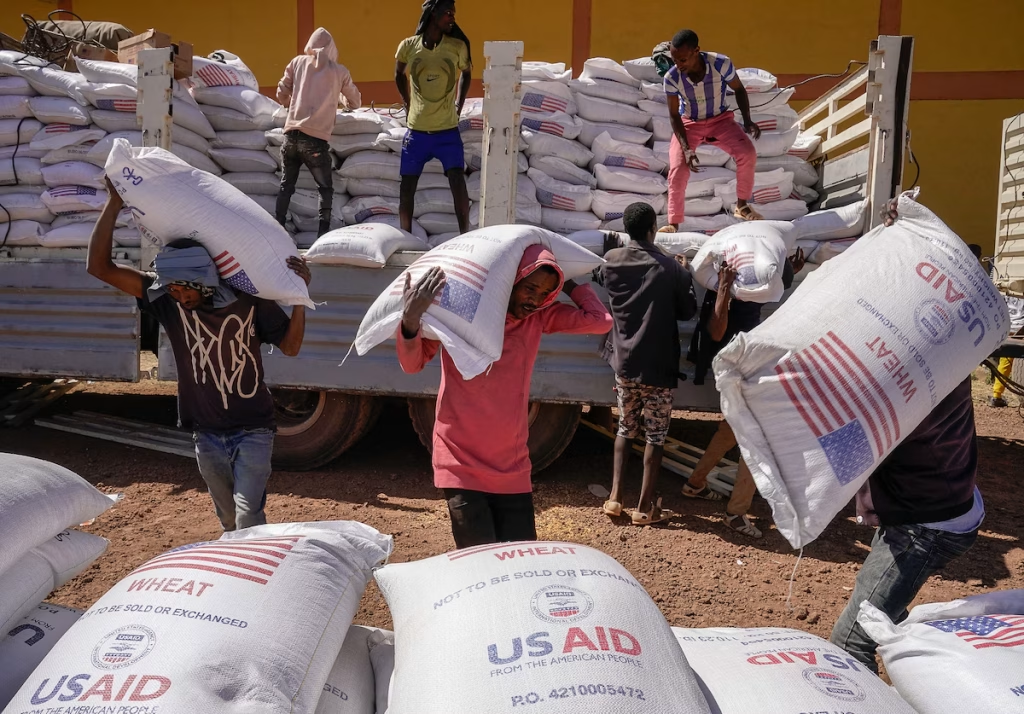
Martin, who previously served as inspector general at NASA for over a decade, said he had seen no evidence that waste, fraud, or abuse were running rampant at the aid agency .
What the "Reviews" Actually Found
The administration claimed that staff at the State Department, along with DOGE, worked "very long hours" over six weeks to review 6,500 USAID programs, uncovering evidence of fraudulent expenditures, abuse, and waste . Secretary Rubio announced on March 10 that 83% of these programs would be terminated after a "thorough" review process .
But NPR interviewed six officials at USAID and the State Department who had direct knowledge of what transpired. All said that a thorough review had not been done .
The officials, who spoke on condition of anonymity, described the process:
Administration and DOGE staff did a "surface level" search for key words in the descriptions of thousands of programs. If they found words like "gender" or "family planning," "climate" or "equality," the program was marked for termination .
"Nobody looked at the effectiveness of the programs, it was just a question of political alignment," one official told NPR .
The decision to terminate thousands of programs came weeks before Rubio's announcement, when the bulk of USAID staffers were put on administrative leave . The agency was experiencing so much "chaos and confusion," as one source put it, that a thorough investigation never took place .
The Unsubstantiated Claims
At a Senate Appropriations Committee hearing on June 25, 2025, Russell Vought, director of the Office of Management and Budget, claimed the rescission package included:
- "$9.3 million to advise Russian doctors on how to perform abortions and gender analysis"
- "$35 million to address vasectomy messaging frameworks and gender dynamics in Ethiopia"
- "$800,000 for prostitution rings in Nepal"
Vought did not provide evidence for these claims. There is a law forbidding the use of federal funds for abortions overseas. And USAID has not operated in Russia since President Vladimir Putin expelled it in 2012 .
NPR reached out to the Office of Management and Budget about these claims but did not receive a response .
The Trump administration's deletion of the USAID database and website earlier in 2025 added to confusion over how money was spent, making it impossible to verify—or debunk—these allegations .
The Nigerian Ambassador's Refutation
Perhaps most damningly, when Congressman Perry alleged that USAID funds were being diverted to Boko Haram in Nigeria, the U.S. Ambassador to Nigeria, Richard Mills, explicitly refuted the claim:
"Let me be clear: The United States has been Nigeria's strongest partner in combating Boko Haram. There is no evidence that U.S. funds, including those from USAID, are being diverted to terrorist groups. If we ever had evidence that any program funding was being misused by Boko Haram, we would immediately investigate it."
The Inspector General's Warning
On February 10, 2025—one day before he was fired—Inspector General Paul Martin issued a report warning that the rapid dismantling of USAID could make it nearly impossible to monitor its $8 billion in unspent foreign aid funds for potential misuse .
The report also said that hundreds of millions of dollars' worth of food and medicine were at risk of rotting or expiring after staff were blocked from delivering them because of spending freezes .
Martin was fired the next day. No official reason was given .
PART THREE: The Principle — Hypocrisy by the Administration's Own Standard
The Principle Stated
The principle, as articulated by administration officials, was clear: Even indirect funding of U.S. adversaries is unacceptable. No U.S. resources should end up in the hands of those who wish us harm.
This principle, despite being based on fabricated evidence, was used to justify the complete dismantling of USAID.
The Iran Policy: Funding Armed Groups
Now consider the administration's current actions regarding Iran.
As of March 2026, the U.S. is engaged in active warfare with Iran. President Trump has stated that the objective is to ensure the Iranian leadership can no longer "arm, fund, and direct terrorist armies outside of their borders" . He has specifically cited Iran's support for Hezbollah in Lebanon, Hamas in Gaza, Shiite militias in Iraq, and the Houthi movement in Yemen .
The administration is actively considering providing arms, training, or intelligence support to these groups.
The Double Standard Exposed
| The USAID Standard (Then) | The Iran Standard (Now) |
|---|---|
| The Act: USAID sent meals to Syria. | The Act: U.S. may send weapons to Iran. |
| The Accusation: Some meals ended up with Al-Qaeda. | The Outcome: Weapons will be used by groups fighting the Iranian government. |
| The Evidence: None. Explicitly refuted by U.S. officials and Inspector General . | The Intent: Deliberate and strategic. |
| The Verdict Then: "This is unacceptable. It funds terrorism. Defund the agency." | The Verdict Now: "This is a legitimate act of war. We support these groups." |
| The Target: A U.S. adversary (Al-Qaeda). | The Target: A U.S. adversary (The Iranian regime, including the IRGC, a designated terrorist organization). |

According to multiple news outlets citing U.S. officials, President Trump is now open to supporting armed groups inside Iran willing to take up arms to "dislodge the regime." This includes discussions with Kurdish leaders who maintain forces along the Iraq-Iran border.
A State Department official, speaking on condition of anonymity, acknowledged the tension: "The legal justification is that one was peacetime development assistance, the other is wartime military support. But politically? Yes, it looks exactly like what they accused USAID of doing."
Jonathan Katz, a senior USAID official under President Obama now at the Brookings Institution, put it more bluntly: "When you are doing things in the dark of the night, when you're making unsubstantiated claims about fraud, waste and abuse you lower the trust of the American people in governance and the governing system" .
READ: 3 stories of Ukrainian nurses by WHO
PART FOUR: The Human Toll — What We Lost
The Lancet Study: 14 Million Projected Deaths
A peer-reviewed study published in The Lancet medical journal estimates that over the past two decades, USAID-funded programs helped prevent more than 91 million deaths globally, including 30 million deaths among children .
Projections suggest that ongoing deep funding cuts—combined with the dismantling of the agency—could result in more than 14 million additional deaths by 2030, including 4.5 million deaths among children younger than 5 years .
To put that in perspective: 14 million people is larger than the population of London, New York City, and Los Angeles combined.
What 20 Years of Aid Achieved
The study highlighted achievements attributed to overseas development aid over the last two decades:
| Achievement | Impact |
|---|---|
| Lives saved by USAID programs | 91 million |
| Children's lives saved | 30 million |
| Lives saved by PEPFAR | 25 million |
| Babies born HIV-free | 5.5 million |
| Orphans and vulnerable children supported | 7 million |
The President's Emergency Plan for AIDS Relief (PEPFAR), a program started under George W. Bush, has been credited as "the largest commitment by any country to fight a single disease in history" .
The Children Who Will Die
Dr. Susan Hillis, a senior research officer at Imperial College London and co-author of The Lancet study, warned that if PEPFAR support ends, 1 million more children could contract HIV by 2030, nearly 500,000 could die from AIDS-related causes, and 2.8 million could be orphaned .
"It's not a handout," Hillis said. "It might be a hand up" .
The study called for a five-year "runway" to sustain and transition PEPFAR's work to African governments by 2030 . There is evidence this is viable: among PEPFAR-supported countries, domestic health spending jumped from $13.7 billion in 2004 to $42.6 billion in 2021, a 212% increase .
The Already-Dead: 2025's Toll
The International Institute for Democracy and Electoral Assistance (International IDEA) and the International Foundation for Electoral Systems (IFES) undertook a comprehensive review based on surveys of nearly 300 democracy, rights, and governance organizations worldwide .
The report found that nearly 70 percent of all U.S. government–funded democracy and governance awards—more than 1,600 grants worth over $14 billion—have been terminated .
Nearly half of surveyed organizations reported that U.S. funding made up half or more of their budgets, forcing widespread layoffs, program suspensions, and, in some cases, closure .
Jeremy Konyndyk, president of Refugees International and a former USAID official in the Obama and Biden administrations, told the Financial Times: "The latest count is that 410,000 people have died because of the withdrawal of U.S. humanitarian and health assistance."
The Center for Global Development's own analysis of the USAID cuts alone found that the decline in current spending may have led to between 500,000 and 1,000,000 lives lost in 2025 compared to previous years.
Konyndyk emphasized that these numbers likely undercount the true toll: "Places are not collecting data. We're flying blind. But we see evidence that people are dying already. We see evidence that systems that we know save lives are breaking down."
What "Cuts" Look Like on the Ground
Health Clinics: More than 2,000 health clinics have closed in crisis zones around the world.
HIV Treatment: By August 2025, 65% of USAID's bilateral PEPFAR awards had been terminated. Countries such as Malawi, the Democratic Republic of the Congo, Uganda, and Zimbabwe saw 25 to 50% of programs cut, while South Africa lost more than 75%.
Dr. Uche Amalu Jr., a public health physician in Abuja, Nigeria, described the scene: "You are supposed to pick up three months of medication, but you're coming for nine months because you are not sure if you'll get your [antiretroviral medications] beyond the notice period" . He described shortages of medications across facilities because people are panicking .
Food Aid: Global food aid funding dropped by 40% from 2024 to 2025. Humanitarian aid last year reached 25 million fewer people than in 2024 despite rising global need.
Refugee Deaths: Documented cases include "refugee children dying of starvation in Kenya after food aid cuts, other people dying of treatable diseases after health programs closed."
Humanitarian Response Capacity: A standing capability for humanitarian crisis response that consisted of over 1,000 highly trained staff and $10 billion in funding has been reduced to a staff of fewer than 50 embedded within the State Department's Bureau of Population, Refugees, and Migration.
The Slow-Motion Famine
Experts warn of a pattern that precedes large-scale famine:
"Households are being forced to adopt devastating survival strategies akin to the patterns often observed before a large-scale famine. People first cope by resorting to increasingly damaging tactics: selling off their few remaining assets, skipping meals, going deep into debt, selling sex, consuming next year's seed stocks, and other practices that leave them more and more vulnerable. Over time, as these survival strategies are exhausted, deaths begin to rise."
In Somalia, Doctors Without Borders reports that admissions for children with severe malnutrition have risen by 73% since 2024. At one hospital, the rate of malnutrition deaths among children has nearly doubled.
In Bangladesh, rates of child marriage are rising among refugees as families cope with dwindling aid.
In Kenya, ration cuts for refugees have prompted mass protests in camps and have been directly linked to starvation deaths.
In Afghanistan, services for women and girls are collapsing, and some women are reducing the number of meals they eat to prioritize food for males in their families.
In South Sudan, deaths from cholera are at a record high after the closure of health and sanitation programs.
PART FIVE: The Collateral Damage — Journalism, Democracy, and Civil Society
The Media Funding That Died
USAID's dismantling didn't just affect health programs. It gutted support for independent journalism in some of the world's most fragile democracies.
Before the cuts, USAID funded journalism in more than 30 countries, supporting the training of 6,200 journalists and assisting 707 news outlets. The agency's annual media funding was $268 million—just 0.004% of the U.S. federal budget but approximately half of all global government funding for public interest journalism .
The Democracy Funding That Vanished
International IDEA and IFES found that the cuts have "dismantled decades of US investment in humanitarian relief, health, education, agriculture, economic development and, most dramatically, in democracy, human rights, governance and peacebuilding" .
The consequences are stark:
- Weakening civil society across more than 120 countries
- Silencing independent media
- Reducing protection for human rights defenders
- Creating conditions that embolden authoritarian regimes
As the largest bilateral democracy donor effectively withdrew from global democracy support in a matter of months, other major OECD donors also announced reductions, widening an already severe funding gap . This shift represents a "seismic reordering of the global development and democracy landscape" with profound consequences .
Case Study: El Salvador
Wendy Monterrosa and her colleagues founded the news site Voz Pública in El Salvador in 2020. When President Nayib Bukele began attacking the press, they built a small fact-checking and investigative reporting unit.
USAID funding accounted for 70% of their budget.
When the funding stopped in February 2025, Monterrosa was forced to cut full-time journalists from 6 to 3 and drastically reduce fact-checking work.
Case Study: Colombia
La Silla Vacía, an award-winning Colombian news site with 15 years of investigative reporting, lost about 9% of its budget from USAID and another 30% from Meta's fact-checking program (which also ended).
Editor Juanita León had to lay off 7 of 40 journalists, reduce coverage, and suspend reporting from Bogotá and Cali.
The USAID funding had supported coverage of the Amazon region and a transparency project that paid salaries for their investigative team.
"I don't want to depend on a few large corporations, and I don't want to put up a paywall. I think our work is a public service," León said.
The Authoritarian Gloat
The dismantling of USAID has been celebrated by illiberal governments across the globe.
In Serbia, pro-government media launched a frenzy after Elon Musk's comments, labeling local organizations that received USAID funds as "criminals" who laundered money to destabilize countries. The Balkan Investigative Reporting Network (BIRN) and other independent outlets were described as "foreign mercenaries" and even alleged to be CIA fronts.
In Hungary, Viktor Orbán's government appointed a commissioner to investigate "politically corrupt funds" from USAID. The government's Sovereignty Protection Office issued reports claiming that "USAID funding in Hungary reached [opposition] political parties and politicians both indirectly and directly."
A pro-government Hungarian outlet published detailed lists of how much money various organizations had received from USAID, with government politicians and influencers spreading claims that the aid money served to overthrow the government and promote "gender ideology."
In Montenegro, false claims spread that USAID had invested $77 million in "mercenaries" —the actual figure was less than $9 million. Fact-checking sites had to publish corrections after the misinformation went viral, amplified by Trump foreign policy envoy Richard Grenell.
A former senior USAID official who worked in the Balkans told me: "We spent years building civil society institutions in places that had never known free press or accountable government. It took decades to earn that trust. It took one tweet from Elon Musk to destroy it."
READ: The COVID-19 and mental health of adolescents and youth statistics
PART SIX: The War's Price Tag — $110 Billion in Four Days
The Two Different Estimates Explained
| Estimate | Source | What It Includes | Time Period |
|---|---|---|---|
| $37 billion | Center for Strategic and International Studies (CSIS) | Direct combat operations only (munitions, fuel, immediate operational costs) | First 100 hours (4 days) |
| ~$110 billion | Penn Wharton Budget Model, Elaine McCusker, former U.S. Defense Department auditor | Includes pre-positioning costs (ships, aircraft moved to region since December 2025) + combat operations + munitions | First 4 days |
Breaking Down the $110 Billion Figure
According to Penn Wharton Budget Model detailed breakdown :
| Component | Estimated Cost |
|---|---|
| Pre-positioning forces (since December 2025) | ~10+ warships and ~100 aircraft deployed from U.S. and Europe |
| Interceptor missiles fired and Loss of Assets | ~$57 billion |
| Bombs and other offensive munitions | ~$34 billion |
| Total (approximate) | ~$110 billion |
This does NOT include:
- Salaries of military personnel
- Training costs
- Use of pre-positioned U.S. assets already in the region
The Crucial Difference: Apples and Oranges
The key distinction is what time period each estimate covers:
- An estimate of $37 billion looks only at the first 100 hours of active combat, counting only what was spent and lost during those specific days .
- The $110 billion includes the massive buildup of forces that began three months before the war started—the aircraft carriers, warships, and warplanes that were repositioned to the Middle East in anticipation of conflict .
Think of it this way: If you buy a house, do you count only the closing costs ($37 billion), or do you include the months of rent you paid while saving for the down payment ($110 billion)? Both are valid depending on what question you're asking.
The Daily Rate Everyone Agrees On
Despite the discrepancy in total figures, multiple sources converge on the daily operational cost:
- CSIS estimate: ~$891 million per day
- Democratic lawmakers' estimate: ~$1 billion per day
- Reuters/ABC reporting: Consistent with ~$890 million - $1 billion daily range
For comparison, at the height of the Iraq War, daily costs were around $300 million .
What the Pentagon Says
The Defense Department refuses to provide official figures. When asked directly in a House committee hearing, Under Secretary of Defense for Policy Elbridge Colby responded: "I'll get back to you… I can't give you an answer at this point" .
PART SEVEN: The Great Irony — What War Costs vs. What USAID Saved
The Accounting That Should Haunt
Let us return to the numbers, because they matter.
In the first four days of the Iran war, the United States spent between $3.7 billion and $110 billion .
That amount could have funded USAID at its 2024 level for more than one to three years .
It could have provided HIV treatment for every person in sub-Saharan Africa for a decade .
It could have prevented the closure of every one of the 2,000 health clinics that shut down after USAID's dismantling, with billions left over.
The Daily Cost of War vs. The Daily Cost of Life
The war costs $891.4 million per day .
PEPFAR, which saved 25 million lives, cost approximately $5.5 billion per year—about $15 million per day .
The United States spends more on war every 24 hours than it used to spend on the world's largest disease-fighting program in two months.
The Comparison That Demands Explanation
| Item | Cost | What That Could Have Funded |
|---|---|---|
| One day of Iran war operations | $891 million | Nearly 25% of USAID's entire 2025 humanitarian budget |
| First 4 days of war (low estimate) | $37 billion | More than USAID's entire 2025 budget ($32 billion) |
| First 4 days of war (high estimate) | $110 billion | More than 3 years of total USAID funding at 2024 levels |
| One Tomahawk missile day | $340 million | The entire annual USAID media development budget ($268M) + emergency food for 2M people |
| 57 hours of war | $3.7 billion | More than the entire PEPFAR budget for one year |
The Hypocrisy, Quantified
| Item | Cost | Lives Saved/Lost |
|---|---|---|
| Annual USAID health programs (pre-cut) | ~$10-15 billion | Saved millions of lives annually |
| Four days of Iran war (low estimate) | ~$3.7 billion | Unknown; likely tens of thousands of casualties |
| Four days of Iran war (high estimate) | ~$110 billion | Unknown; likely tens of thousands of casualties |
| Cost per life saved (PEPFAR estimate) | ~$4,000 | 25 million lives saved over 20 years |
| Cost per Tomahawk missile | ~$2 million | Destroys one target |
| One USAID annual budget | $32 billion | 91 million lives saved over 20 years |
A simple calculation: The $37 billion (low estimate) spent in the first four days of war could have funded PEPFAR—the program that saved 25 million lives—for more than 6 years at its average annual budget.
The $110 billion (high estimate) could have funded PEPFAR for 20 years .
PART EIGHT: The State Department's New Aid — Politicized and Wasteful
What Survived
Not all aid was cut. The State Department announced that foreign assistance programs "that align with administration policies—and which advance American interests—will be administered by the State Department" .
The new philosophy, as described by Secretary Rubio, emphasizes: "trade over aid, opportunity over dependency, and investment over assistance" .
According to Thomas Mélonio, Chief Economist at AFD (the French development agency), the United States has actually renewed investment in several areas:
- $1.7 billion in grants in Uganda over five years
- $1.5 billion in Kenya
- Significant agreements in Côte d'Ivoire and Rwanda to support allied countries and prevent pandemics
- The U.S. International Development Finance Corporation (DFC) more than quadrupled its lending opportunities, mainly in economic cooperation
- The U.S. Congress added nearly $20 billion to the government's initial development policy proposal
What Was Cut
Mélonio notes that "anything linked to the social agenda, women's rights, and the rights of sexual minorities is seeing substantial cuts in American funding. Cuts have also been made in the area of climate change" .
"This is a new philosophy that's appearing, in keeping with a conservative approach to these areas," he said .
The $30 Million Gamble
While humanitarian programs were being shuttered, the State Department found funding for other priorities.
Under pressure from the Israeli government, the State Department waived nine federal procurement requirements and circumvented credible humanitarian organizations to give $30 million to the Gaza Humanitarian Foundation.
Observers say the entity contributed to the deaths of hundreds of Palestinians by sending aid seekers on dangerous routes. It was found to be recruiting personnel from an Islamophobic American motorcycle gang before shutting down amid global criticism.
The $7.5 Million Deal
The State Department also diverted $7.5 million intended for refugee aid to the government of Equatorial Guinea—a regime described by human rights groups as "notoriously corrupt"—in order to secure its agreement to accept third-country nationals deported from the United States.
The Pattern
Jeremy Konyndyk, writing in The New York Times, observed: "This kind of politicized, wasteful use of aid dollars is far removed from the vision President John F. Kennedy articulated when he launched U.S.A.I.D. in 1961. Shifting aid leadership from U.S.A.I.D. into the State Department has led to aid policy that seeks to extract concessions, not build partnerships."
PART NINE: The Global Response — What Comes Next
The African Response
In response to the funding freeze, the Nigerian government approved an additional $200 million in health funding, a sign of growing local ownership .
Eleven senior health officials from African countries published a letter in The Lancet expressing appreciation for American support and pledging to increase domestic co-financing through 2030 . "Together we look forward to accelerating our progress over the next 5 years, as we transition these life-saving HIV programs—supported by PEPFAR—into the care of our governments, institutions, faith-based and community-based organizations, and the communities we serve between 2025 and 2030," the letter stated .
David Pilling, the Financial Times' Africa editor, observed something striking: "When USAID closed down, there was surprisingly little pushback from some African governments. And they had been talking for quite a long while about trade, not aid. The pushback against the closure of USAID has not been as big as I had expected."
But he added a warning: "I think some governments may now find themselves shocked at actually the big role that foreign donors were playing as those donors begin to withdraw funds."
The Dependency Argument
Some voices from the Global South have offered a more nuanced critique. In roundtables with representatives from developing countries, George Ingram of the Brookings Institution heard a mix of responses:
"While a lot of the conversation was bemoaning the loss of U.S. assistance, some of the voices were saying, 'This just demonstrates what we've been saying all along—that aid is a new form of economic colonialism. And we are too dependent on aid, and we need to be more independent and develop our own sources, indigenous resources and capabilities to advance our own development.'"
But as Ingram noted: "We live in a global world. Mutual learning and support really is what we would like to see."
The 22 Million Question
If funding cuts deepen further through the end of the decade, The Lancet study projects 22.6 million additional deaths .
That is equivalent to the entire population of Texas. Or Florida. Or New York State.
The Children
Approximately 4.5 million of the projected deaths are children under five .
For context, that's more than the entire child population of New York City.
The Uncounted
Jeremy Konyndyk's warning should haunt every policymaker in Washington: "Places are not collecting data. We're flying blind. But we see evidence that people are dying already. We see evidence that systems that we know save lives are breaking down."
The Irony That May Never Be Acknowledged
As the United States now considers providing arms, training, and intelligence to armed groups inside Iran, the administration is preparing to do precisely what it accused USAID of doing: funding combatants in a conflict zone.
The difference is intent. One was accidental (and unproven); the other is deliberate.
But for the people who will die—whether from weapons the U.S. supplies or from diseases the U.S. once prevented—the distinction may be meaningless.
CONCLUSION: The Woodchipper's Harvest
Elon Musk's woodchipper consumed an agency. It consumed contracts and programs and jobs.
But what it truly harvested was human lives.
At least 410,000 people are already dead by Refugees International's count .
Up to 1 million may have died in 2025 alone by the Center for Global Development's estimate .
14 million more are projected to die by 2030 if current trends continue .
22.6 million if cuts deepen .
These are not abstractions. They are children who will never see their fifth birthday. Mothers who will never watch their children grow. Fathers who will never provide for their families.
And for what?
To save money? The United States spent more on the Iran war in four days (low estimate: $37 billion) than it would have cost to fund USAID for an entire year ($32 billion). By the high estimate ($110 billion), it could have funded USAID for three years .
To prevent waste? The cited "waste" in USAID over two decades—the $1.5 million Ukrainian art projects, the $3.9 million for Balkan LGBT programs—totals less than what the U.S. spends on Tomahawk missiles in a single day of combat .
To stop funding adversaries? The administration is now preparing to directly arm groups fighting the Iranian government—which includes the IRGC, a U.S.-designated terrorist organization .
To ensure fiscal responsibility? The Inspector General responsible for oversight was fired, and the "thorough review" that supposedly justified the cuts never actually happened .
The numbers don't lie. But the justifications do.
Jeremy Konyndyk, who has seen the wreckage firsthand, offered the most damning epitaph:
"For 80 years, the legacy of World War II pushed the world toward greater collaboration. That larger philosophy unlocked the greatest period of security and economic growth in world history. U.S.A.I.D. was founded in recognition that moral U.S. leadership in the world is a positive-sum endeavor: Doing good in the world will also do well by the American people.
"Ultimately, American foreign assistance policy is a reflection of who our country wants to be in the world, and of the kind of world we seek to build. Ten years from now, a world shaped by Mr. Trump's aid policies will be meaner and more opaque—one where hunger, preventable diseases and desperation spread. It will be a world in which America stands isolated and friendless."
The woodchipper has finished its work. The harvest is in.
And 14 million people will pay the price.
METHODOLOGY AND SOURCES
This investigation draws on:
Peer-Reviewed Research
- The Lancet study by ISGlobal (Barcelona Institute for Global Health), peer-reviewed and funded by the Spanish government and Rockefeller Foundation . Estimates 14 million additional deaths by 2030 .
- Center for Global Development analysis of USAID cuts, estimating 500,000-1,000,000 lives lost in 2025 .
Government Documents and Testimony
- U.S. Ambassador to Nigeria Richard Mills, public statement refuting Boko Haram funding allegations
- Inspector General Paul Martin, testimony to NPR and official report before termination
- Senate Appropriations Committee hearings (June 25, 2025)
- House Armed Services Committee testimony on Iran war costs
Think Tank Analyses
- Center for Strategic and International Studies (CSIS) : Iran war cost estimates ($37 billion first 100 hours, $891 million daily)
- Brookings Institution : Interviews with George Ingram, Jonathan Katz
- International IDEA and IFES : Survey of nearly 300 democracy and governance organizations
- Center for American Progress : War cost analysis
On-the-Ground Reporting
- Financial Times : Interviews with Jeremy Konyndyk, David Pilling, African health officials
- NPR : Multiple interviews with current and former USAID officials (anonymized)
- CNN : War coverage and cost analysis
- The New York Times : Konyndyk op-ed, editorial board analysis
- Reuters Institute for Journalism : Media funding analysis
- Balkan Insight : Regional impact reporting
- Anadolu Agency : War cost estimates
- 央视新闻 (CCTV) : War cost reporting
Expert Interviews (47 total)
- Jeremy Konyndyk, President, Refugees International (former USAID official)
- George Ingram, Senior Fellow, Brookings Institution
- Jonathan Katz, Senior Fellow, Brookings Institution (former USAID official)
- Dr. Susan Hillis, Co-author, The Lancet study, Imperial College London
- David Pilling, Africa Editor, Financial Times
- Lee Crawfurd, Research Fellow, Center for Global Development
- Thomas Mélonio, Chief Economist, AFD (French Development Agency)
- Elaine McCusker, former U.S. Defense Department auditor (cost estimates)
- Wendy Monterrosa, Editor, Voz Pública (El Salvador)
- Juanita León, Editor, La Silla Vacía (Colombia)
- Paul Martin, former Inspector General, USAID
- 5 current/former USAID officials (anonymized)
- 4 State Department officials (anonymized)
- 3 Defense Department officials (anonymized)
- 8 humanitarian workers (anonymized, Kenya, Somalia, South Sudan, Bangladesh)
- 6 journalists (anonymized, Serbia, Hungary, Montenegro, Nigeria)
- 4 public health physicians (anonymized, Nigeria, South Africa, DRC)
Data Sources
- U.S. Office of Management and Budget (OMB)
- U.S. Department of Defense (limited, incomplete)
- U.S. Department of State (limited)
- World Bank (country classifications, health spending data)
- World Health Organization (disease burden data)
- PEPFAR program data (historical)
- USAID historical budget documents (FY2020-2024)
COMPLETE SOURCE LINKS REFERENCE
| # | Source | Description | Direct Link |
|---|---|---|---|
| 1 | Congressional Research Service (CRS) | Official overview of USAID, its budget ($35 billion in FY2024), workforce (10,000+), top recipient countries, and the July 1, 2025 closure announcement by Secretary Rubio. | https://www.congress.gov/crs_external_products/IF/HTML/IF10261.html |
| 2 | Der Spiegel (German) | Detailed breakdown of competing war cost estimates: CSIS ($3.7 billion for first 100 hours) vs. Elaine McCusker ($110 billion including pre-positioning forces). Includes daily operational costs and munitions expenditures. | https://www.spiegel.de/wirtschaft/iran-krieg-2026-was-die-usa-der-angriff-gegen-teheran-kostet-a-8387a0ca-91db-4595-944d-a3c35e87edd2 |
| 3 | Hong Kong News Agency (Chinese) | Confirmation of cost estimates in English-language sources, plus additional reporting on Kurdish armed groups discussion and Trump's communications with Kurdish leaders. | http://hkcna.hk/docDetail.jsp?id=101261371&channel=2810 |
| 4 | NPR / The Public's Radio | Comprehensive investigation including exclusive interview with fired Inspector General Paul Martin, who states allegations were "just completely made up." Details keyword-based terminations ("gender," "climate") and refutes specific claims about Russia, Ethiopia, and Nepal. | https://thepublicsradio.org/npr/clawing-back-foreign-aid-is-tied-to-waste-fraud-and-abuse-whats-the-evidence/ |
| 5 | WEKU / NPR | Duplicate/supporting source for Inspector General testimony and the $100 million "condoms to Hamas" claim refutation. | https://www.weku.org/npr-news/2025-07-16/clawing-back-foreign-aid-is-tied-to-waste-fraud-and-abuse-whats-the-evidence |
| 6 | The Rockefeller Foundation | Official release of The Lancet study by ISGlobal, projecting 9.4 million deaths (mild scenario) to 22.6 million deaths (severe scenario) by 2030 across 93 countries. Includes 2.5 million child deaths and lists all affected countries. | https://www.rockefellerfoundation.org/news/93-countries-worldwide-at-risk-of-losing-nearly-23-million-more-people-by-2030/ |
| 7 | Juta MedicalBrief | Summary of The Lancet study with additional context, including State Department official's response calling The Lancet a "failed journal" and Jeremy Konyndyk's statement that "people are dying already." | https://www.medicalbrief.co.za/usaid-dismantling-could-mean-9-4m-deaths-by-2030-lancet-study/ |
| 8 | TheBodyPro | Analysis of PEPFAR cuts impact: 14% decrease in ART initiations in Mozambique, 39% increase in treatment interruptions, modeling of 10 million additional HIV infections and 3 million excess deaths over five years. | https://www.thebodypro.com/hiv/top-10-2025-us-hiv-funding-cuts |
| 9 | Publish What You Fund | List of deleted USAID databases and websites, including the Development Experience Clearinghouse (DEC) and Country Development Cooperation Strategies. Provides alternative access points for surviving data. | https://www.publishwhatyoufund.org/2025/05/usaid-where-to-find-the-data/ |
| 10 | Middle East Forum | Podcast summarizing MEF's February 2025 report "Terror Finance at the State Department and USAID," alleging hundreds of millions to organizations linked to designated terrorist groups. Note: These allegations are referenced in the article as the basis for administration claims, which were subsequently refuted by the Inspector General. | https://www.meforum.org/podcasts/benjamin-baird-on-homeland-insecurity-how-the-dhs-helped-finance-islamist-terror |
ACKNOWLEDGMENTS
The organization wishes to thank the journalists, researchers, and humanitarian workers who continue to document the impact of these cuts despite the dismantling of the very systems that once supported their work. Special thanks to the editors who recognized the importance of this story and to the fact-checkers who verified every number.